A young manager accosted me the other day. “I’ve been reading all
about leadership, have implemented several ideas, and think I’m doing a good
job at leading my team. How will I know when I’ve crossed over from being a
manager to a leader?” he wanted to know.
I didn’t have a ready answer and it’s a complicated issue, so we
decided to talk the next day. I thought long and hard, and came up with three
tests that will help you decide if you’ve made the shift from managing people
to leading them.
Counting value vs Creating value. You’re probably counting value, not adding it, if you’re
managing people. Only managers count value; some even reduce value by disabling
those who add value. If a diamond cutter is asked to report every 15 minutes
how many stones he has cut, by distracting him, his boss is subtracting value.
By contrast, leaders focuses on creating value, saying: “I’d like
you to handle A while I deal with B.” He or she generates value over and above
that which the team creates, and is as much a value-creator as his or her
followers are. Leading by example and leading by enabling people are the
hallmarks of action-based leadership.
Circles of influence vs Circles of power. Just as managers have subordinates and leaders have
followers, managers create circles of power while leaders create circles of
influence.
The quickest way to figure out which of the two you’re doing is to
count the number of people outside your reporting hierarchy who come to you for
advice. The more that do, the more likely it is that you are perceived to be a
leader.
Leading people vs Managing work. Management consists of controlling a group or a set of entities
to accomplish a goal. Leadership refers to an individual’s ability to
influence, motivate, and enable others to contribute toward organizational
success. Influence and inspiration separate leaders from managers, not power
and control.
In India, M.K. Gandhi inspired millions of people to fight for
their rights, and he walked shoulder to shoulder with them so India could
achieve independence in 1947. His vision became everyone’s dream and ensured
that the country’s push for independence was unstoppable. The world needs
leaders like him who can think beyond problems, have a vision, and inspire
people to convert challenges into opportunities, a step at a time.

I encouraged my colleague to put this theory to the test by
inviting his team-mates for chats. When they stop discussing the tasks at hand
— and talk about vision, purpose, and aspirations instead, that’s when you will
know you have become a leader.
Adapted from “The Wall Street Journal Guide to Management” by Alan
Murray, published by Harper Business.
Leadership and management must go hand in hand. They are not the
same thing. But they are necessarily linked, and complementary. Any effort to
separate the two is likely to cause more problems than it solves.
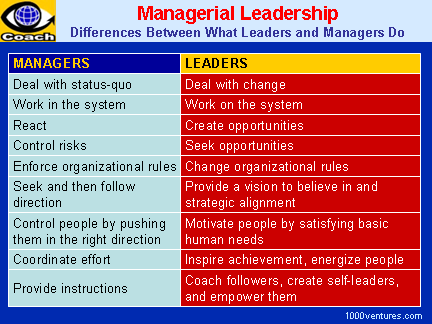
Still, much ink has been spent delineating the differences. The
manager’s job is to plan, organize and coordinate. The leader’s job is to
inspire and motivate. In his 1989 book “On Becoming a Leader,” Warren Bennis
composed a list of the differences:
– The manager administers; the leader innovates.
– The manager is a copy; the leader is an original.
– The manager maintains; the leader develops.
– The manager focuses on systems and structure; the leader focuses
on people.
– The manager relies on control; the leader inspires trust.
– The manager has a short-range view; the leader has a long-range
perspective.
– The manager asks how and when; the leader asks what and why.
– The manager has his or her eye always on the bottom line; the
leader’s eye is on the horizon.
– The manager imitates; the leader originates.
– The manager accepts the status quo; the leader challenges it.
– The manager is the classic good soldier; the leader is his or
her own person.
– The manager does things right; the leader does the right thing.
Perhaps there was a time when the calling of the manager and that
of the leader could be separated. A foreman in an industrial-era factory
probably didn’t have to give much thought to what he was producing or to the
people who were producing it. His or her job was to follow orders, organize the
work, assign the right people to the necessary tasks, coordinate the results,
and ensure the job got done as ordered. The focus was on efficiency.
But in the new economy, where value comes increasingly from the
knowledge of people, and where workers are no longer undifferentiated cogs in
an industrial machine, management and leadership are not easily separated.
People look to their managers, not just to assign them a task, but to define
for them a purpose. And managers must organize workers, not just to maximize
efficiency, but to nurture skills, develop talent and inspire results.
The late management guru Peter Drucker was one of the first to
recognize this truth, as he was to recognize so many other management truths.
He identified the emergence of the “knowledge worker,” and the profound
differences that would cause in the way business was organized.
With the rise of the knowledge worker, “one does not ‘manage’
people,” Mr. Drucker wrote. “The task is to lead people. And the goal is to
make productive the specific strengths and knowledge of every individual.”

No comments:
Post a Comment